
Periodization in Sports Training
Periodization is an important concept in sports training. It helps coaches and athletes organize training in a systematic way so that the athlete can gradually improve performance and reach peak performance at the right time.
In simple words, periodization means dividing the complete training year into smaller phases or periods, with each phase having a specific training objective.
What is Periodization?
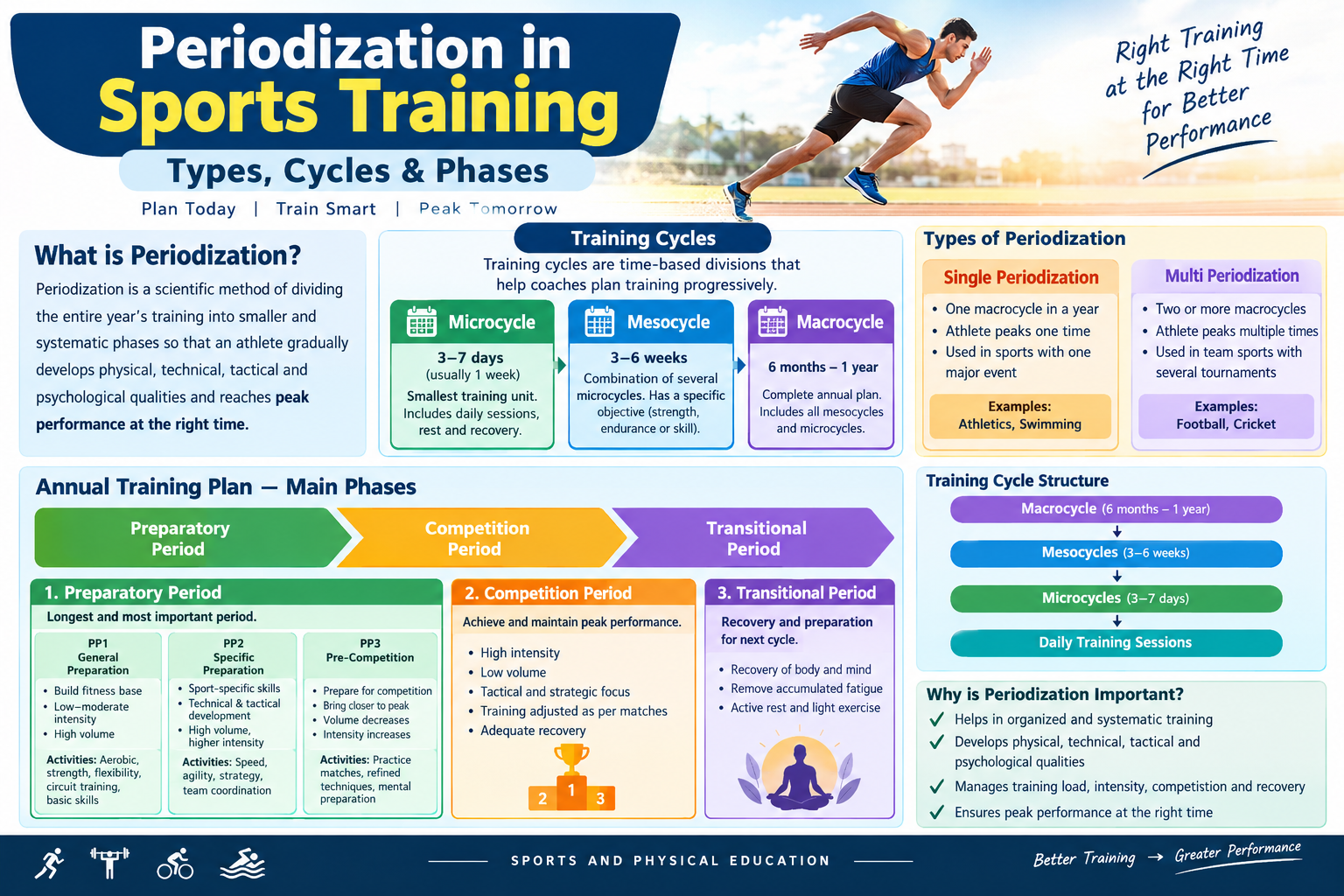
Periodization is a scientific method of dividing the entire year’s training into smaller and systematic phases. These phases help develop the athlete’s physical, technical, tactical, and psychological qualities step by step.
The main aim is to help the athlete achieve peak performance during the main competition.
Instead of following the same training routine throughout the year, the training load, intensity, volume, skills, and recovery are changed according to the needs of each phase.
Training Cycles in Periodization
Training cycles are time-based divisions that help coaches plan training progressively. There are three major training cycles:
1. Microcycle
A microcycle is the smallest training unit.
Duration: 3–7 days, normally one week.
It includes daily training sessions, rest days, training load, and recovery. Coaches use microcycles to organize what an athlete will do during a short period.
2. Mesocycle
A mesocycle is a combination of several microcycles.
Duration: 3–6 weeks.
Each mesocycle normally has a specific objective. For example:
- Strength development
- Endurance development
- Skill development
Thus, several short microcycles are organized together to achieve a particular training goal.
3. Macrocycle
A macrocycle is the largest training cycle.
Duration: 6 months to 1 year.
It represents the complete annual training plan and includes different mesocycles and microcycles.
Training Cycle Structure
Macrocycle → Mesocycles → Microcycles → Daily Training Sessions
This structure helps the coach organize training from a long-term goal to individual daily sessions.
Types of Periodization
There are two main types of periodization:
1. Single Periodization
In single periodization, there is only one macrocycle in a year.
The athlete reaches peak performance one time during the year.
It is suitable for sports where there is one major competition or important event.
Examples: Athletics and Swimming.
2. Multi Periodization
In multi periodization, there are two or more macrocycles in a year.
The athlete reaches peak performance multiple times.
This type is useful in sports where athletes have several important tournaments or competitions during the year.
Examples: Football and Cricket.
Annual Training Plan
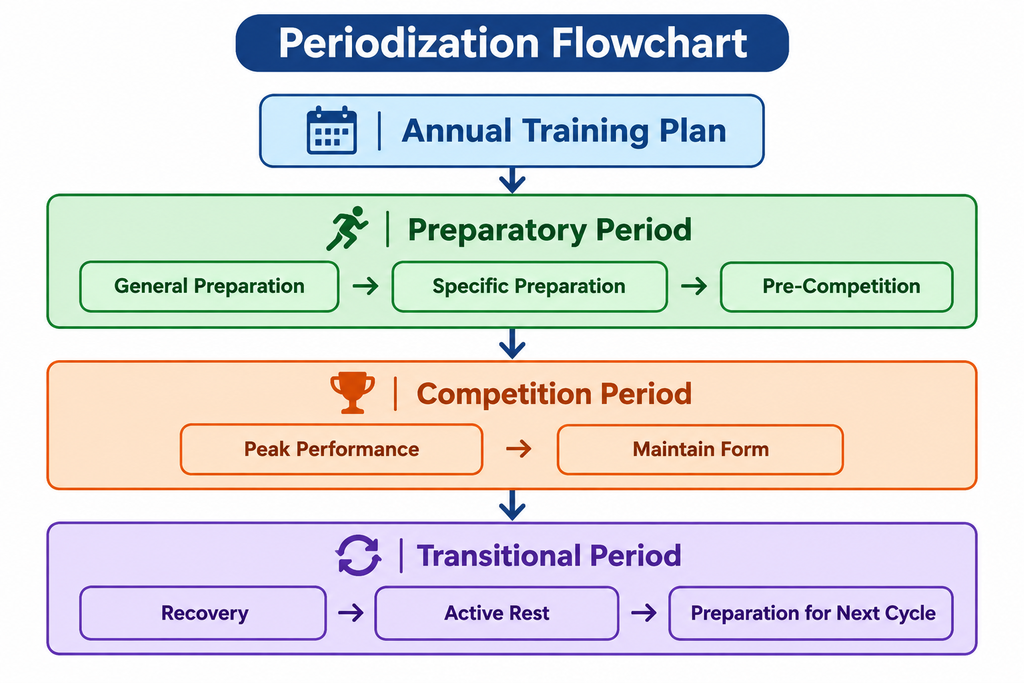
The annual training plan is divided into three main periods:
Preparatory Period → Competition Period → Transitional Period
Each period has a different purpose and training focus.
1. Preparatory Period
The Preparatory Period is the longest and most important period of annual training.
It is divided into three sub-phases:
General Preparation Phase (PP1)
The main purpose of the General Preparation Phase is to build a strong general fitness base and improve overall physical conditioning.
Main characteristics:
- High training volume
- Low to moderate intensity
- Development of general fitness
Activities may include:
- Aerobic endurance
- Strength training
- Flexibility exercises
- Circuit training
- Basic skills
This phase creates the foundation for more specific training.
Specific Preparation Phase (PP2)
In the Specific Preparation Phase, training becomes more closely related to the athlete’s sport.
Main objectives:
- Develop sport-specific abilities
- Improve technical skills
- Improve tactical skills
The intensity increases while the volume remains high.
Training may include sport-specific endurance, speed, agility, strategy, and positional training. In team games, combination play and team coordination are also emphasized.
Pre-Competition Phase (PP3)
The Pre-Competition Phase prepares the athlete for the upcoming competition and brings the athlete closer to peak performance.
Main characteristics:
- Training volume decreases
- Intensity increases sharply
- Practice matches are included
- Training becomes highly specific
- Techniques are refined
Technical and mental preparation also become very important during this phase.
2. Competition Period
The main purpose of the Competition Period is to achieve peak performance and maintain good form throughout the competition season.
Main characteristics:
- High intensity
- Low volume
- Tactical and strategic focus
- Training loads adjusted according to matches
- Adequate recovery
During this period, the athlete is expected to perform at a high level, so unnecessary training fatigue should be avoided.
3. Transitional Period
The Transitional Period is also called the Rest Phase.
Its main purpose is to allow the athlete’s body and mind to recover after the training and competition season.
Main objectives:
- Recovery of body and mind
- Removal of accumulated fatigue
- Preparation for the next training cycle
The athlete may perform light general exercises, recreational games, and other forms of active rest.
The aim is to keep the athlete active while allowing sufficient recovery and refreshment.
Importance of Periodization in Sports Training
Periodization helps in organizing training according to the athlete’s needs at different times of the year. It allows physical, technical, tactical, and psychological qualities to be developed progressively.
It also helps coaches manage training volume, intensity, competition demands, and recovery more effectively.
Most importantly, the overall plan is designed so that the athlete can reach peak performance at the right time, particularly during the main competition.
Quick Revision for Competitive Exams
| Topic | Key Point |
|---|---|
| Periodization | Division of annual training into systematic phases |
| Microcycle | 3–7 days |
| Mesocycle | 3–6 weeks |
| Macrocycle | 6 months–1 year |
| Single Periodization | One peak in a year |
| Multi Periodization | Multiple peaks in a year |
| Preparatory Period | Longest and most important period |
| PP1 | General Preparation |
| PP2 | Specific Preparation |
| PP3 | Pre-Competition |
| Competition Period | Peak performance and maintenance |
| Transitional Period | Recovery and active rest |
Frequently Asked Questions
What is periodization in sports training?
Periodization is the systematic division of an annual training plan into smaller phases to progressively develop an athlete and help achieve peak performance at the appropriate competition.
What are the three training cycles?
The three training cycles are microcycle, mesocycle, and macrocycle.
What is the duration of a microcycle?
A microcycle generally lasts 3–7 days, normally one week.
What is a macrocycle?
A macrocycle is the complete long-term training plan, generally lasting 6 months to 1 year.
What are the three main periods of annual training?
The three main periods are Preparatory Period, Competition Period, and Transitional Period.
What is single periodization?
Single periodization has one macrocycle in a year, with the athlete reaching peak performance once.
What is multi periodization?
Multi periodization has two or more macrocycles, allowing the athlete to reach peak performance multiple times.
Conclusion
Periodization provides a systematic structure for sports training. It divides the annual plan into different cycles and phases, starting with general preparation and progressing toward specific preparation, competition, and recovery.
Understanding microcycle, mesocycle, macrocycle, single and multi periodization, and the three main training periods is important for both Physical Education students and competitive-exam aspirants.
A well-planned periodization program helps an athlete develop progressively and aims to ensure peak performance at the right time.
You can also check video Periodization in Sports Training on our youtube channel. Check other blogs on Sport Training Here!