Training Load and Recovery in Sports Training
Training is an important part of improving sports performance. During training, an athlete performs physical activities that place stress on the body. This stress is known as training load. However, training alone is not enough for better performance. The body also needs proper recovery to repair, restore and adapt.
The relationship between training load and recovery is therefore very important for athletes, coaches, physical education students and competitive-exam aspirants.
What is Training Load?
Training load is the amount of stress, including work and pressure, placed on an athlete’s body during training or competition.
During training, the body becomes tired, energy is used and muscles experience stress. This creates a temporary disturbance in the body’s balance, known as homeostasis.
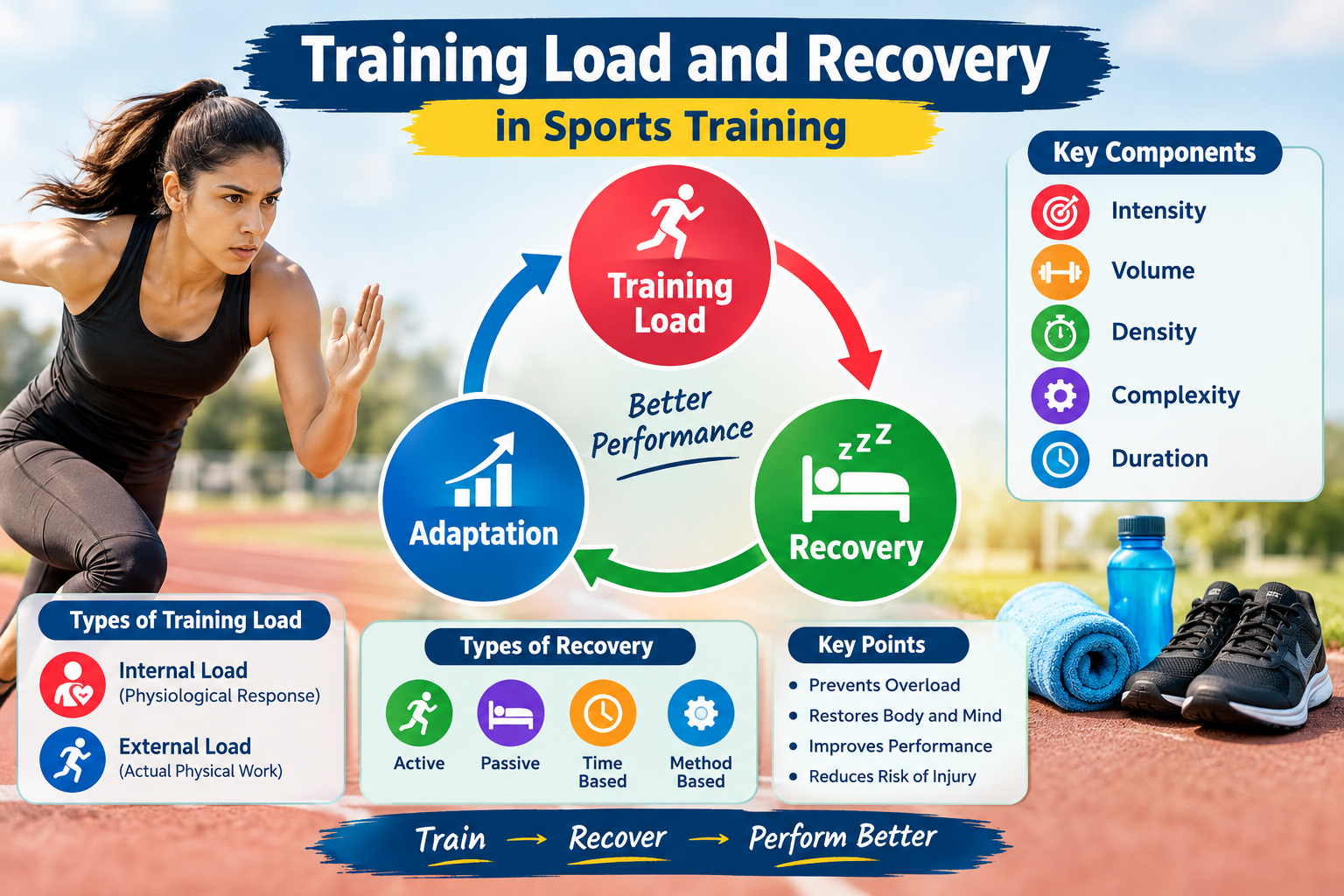
Training load can be understood through different components such as intensity, volume, density, complexity and duration.
Components of Training Load
1. Intensity
Intensity refers to the level of difficulty of an exercise.
For example, running at 80% of maximum heart rate represents high-intensity exercise.
2. Volume
Volume means the total amount of training performed. It can be measured through time, distance or repetitions.
For example, completing 5 sets of 20 push-ups represents a particular training volume.
3. Density
Density refers to the relationship between work and rest during a training session.
For example, 30 seconds of sprinting followed by 30 seconds of rest represents a high work-to-rest density.
4. Complexity
Complexity refers to the difficulty of the skill or technique involved in an activity.
A gymnastics routine involving flips and turns is an example of a highly complex activity.
5. Duration
Duration means the length of a training session.
For example, running continuously for 60 minutes represents the duration of the training session.
Types of Training Load
Training load can mainly be divided into internal load and external load.
Internal or Inner Load
Internal load refers to how the body responds physiologically to training. It shows how hard the heart, muscles and mind are working during an activity.
Examples include:
- Sweating
- Fatigue
- Loss of concentration
- Loss of coordination
- Decline in movement quality
External or Outer Load
External load refers to the actual physical work performed by an athlete. It includes factors such as distance covered, weight lifted, type of activity and frequency of training.
For example, running 5 km at a certain speed, lifting weights and swimming laps are examples of external training load.
What is Overload?
Overload occurs when the training load goes beyond an athlete’s capacity. Instead of improving performance, excessive load can reduce performance.
Some causes of overload include:
- Poor environment
- Health issues
- Lifestyle problems such as poor sleep, improper diet and stress
- Faulty training methods
Common symptoms include poor performance, lack of energy, avoiding the coach or teammates and slower recovery.
What is Recovery?
Recovery is the process through which the body repairs, restores and adapts after the stress of training.
During training, the muscles, nervous system and energy stores are placed under stress. Recovery helps these systems return towards balance and supports adaptations such as improved strength, endurance and skill.
Proper recovery also helps an athlete perform better in the next training session and helps prevent injuries and overtraining.
Types of Recovery
Recovery can be classified in different ways.
Based on Activity
Active Recovery: Light physical activity after training that promotes blood circulation. Examples include light jogging, cycling and stretching.
Passive Recovery: Complete rest without physical activity. Sitting, lying down and sleeping are examples.
Based on Time
Immediate Recovery: Recovery during the first 0–2 hours after exercise. It includes short breaks during training or competition, along with attention to hydration and protein/carbohydrate intake.
Short-Term Recovery: Recovery within 24 hours after daily training. It may include cool-down, sleep, meals, light stretching and mobility exercises.
Long-Term Recovery: Recovery of 48–72 hours or more between training phases, camps or competitive seasons. It may involve full rest or light training after high-intensity sessions.
Recovery Based on Means or Methods
Recovery can also be classified according to the methods used:
Physiological Recovery: Includes sleep, relaxation, hydration and restoration of energy stores.
Nutritional Recovery: Includes carbohydrates, proteins, fluids and electrolytes.
Therapeutic Recovery: Includes methods such as massage, hydrotherapy, cryotherapy, sauna, yoga, stretching and physiotherapy.
Recovery Based on Nature of Load
There are three forms:
Physical Recovery: Focuses on muscles, energy systems and joints.
Psychological Recovery: Includes mental relaxation, stress management, motivation and enjoyment.
Social Recovery: Involves spending time with family, enjoying hobbies and participating in non-sport activities for mental freshness.
Training Load, Recovery and Adaptation Cycle
The basic relationship can be understood as:
Training Load → Recovery → Adaptation
Training load creates stress on the body. Recovery allows the body to rest and restore itself. Adaptation then helps the athlete perform better than before.
Therefore, an effective training programme requires a proper balance between training load and recovery.
Conclusion
Training load and recovery are two important parts of sports training. Training provides the necessary stress for improvement, while recovery allows the body to repair, restore and adapt. Understanding intensity, volume, density, complexity, duration, internal load, external load, overload and different types of recovery is important for athletes as well as students preparing for physical education examinations.
For competitive exams, remember the key cycle: Training Load → Recovery → Adaptation.
You can also check video Training Load and Recovery on our youtube channel.