Methods Of Flexibility Development
Flexibility is one of the most important components of physical fitness, as it allows the body to move freely and efficiently through a full range of motion. Understanding the different methods of flexibility development is essential. Among the most widely used techniques are Ballistic Stretching, Static Stretching (Slow Stretch and Hold Method), and PNF Stretching (Post-Isometric Stretching). Each method has its own technique, purpose, benefits, and level of effectiveness.
Ballistic Stretching Method
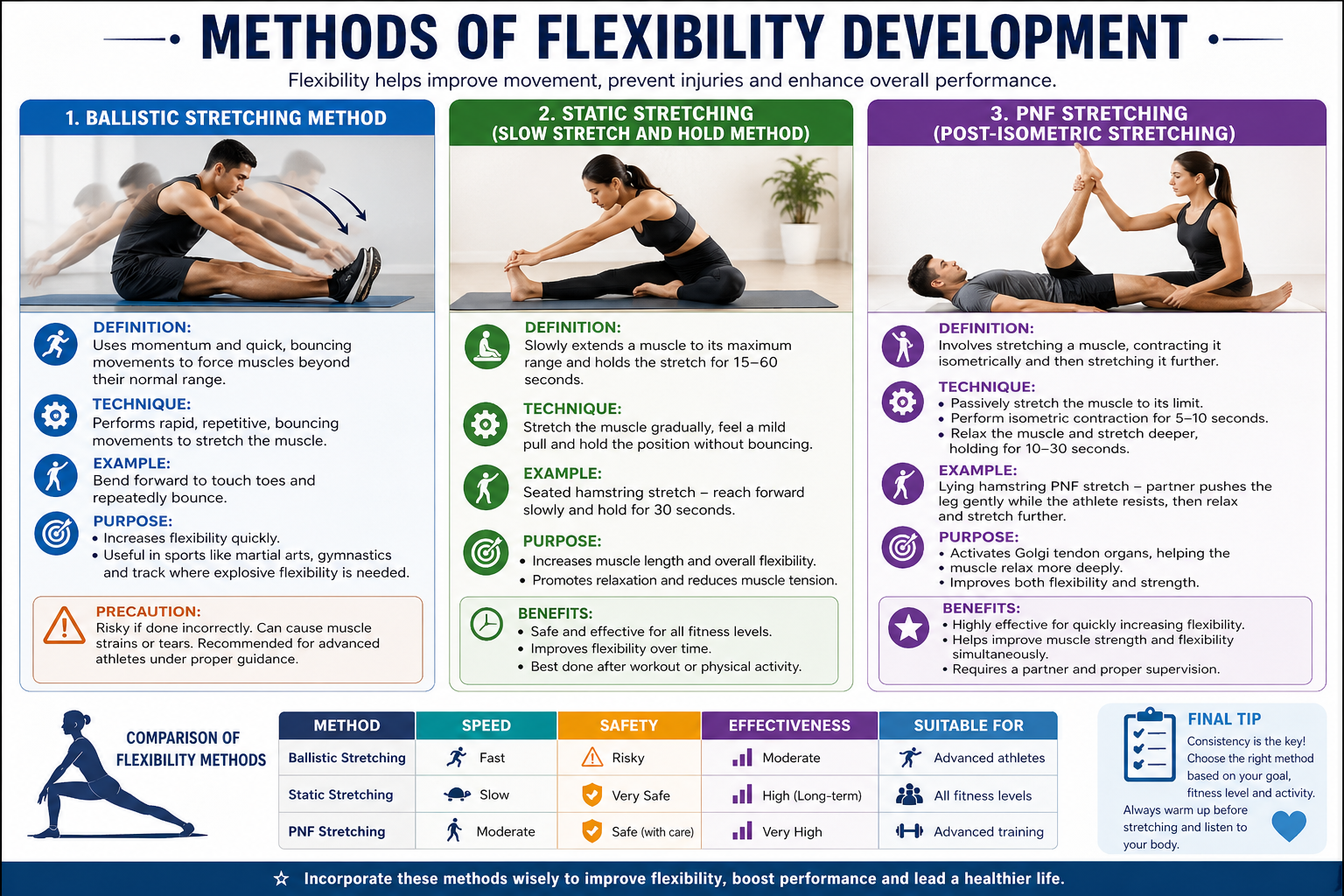
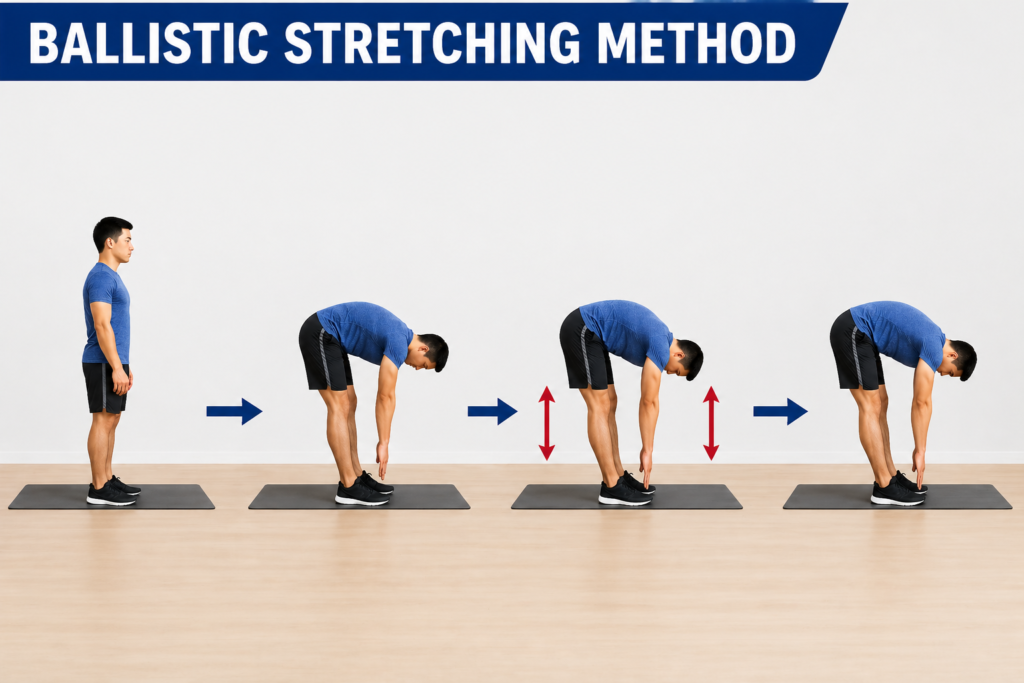
Definition: Ballistic stretching uses the momentum of a moving body or limb to force it beyond its normal range of motion. It involves quick, bouncing movements to stretch the muscle.
Technique: The athlete performs rapid, repetitive movements that push the muscles into an extended range, typically using a bouncing motion.
For example- a person might bend forward to touch their toes and repeatedly bounce to increase the stretch.
Purpose:
- Increases flexibility rapidly by forcing the muscle to extend quickly.
- Mimics dynamic movements in certain sports, making it useful in sports like martial arts and track, where explosive flexibility is needed.
Slow Stretch and Hold Method (Static Stretching)
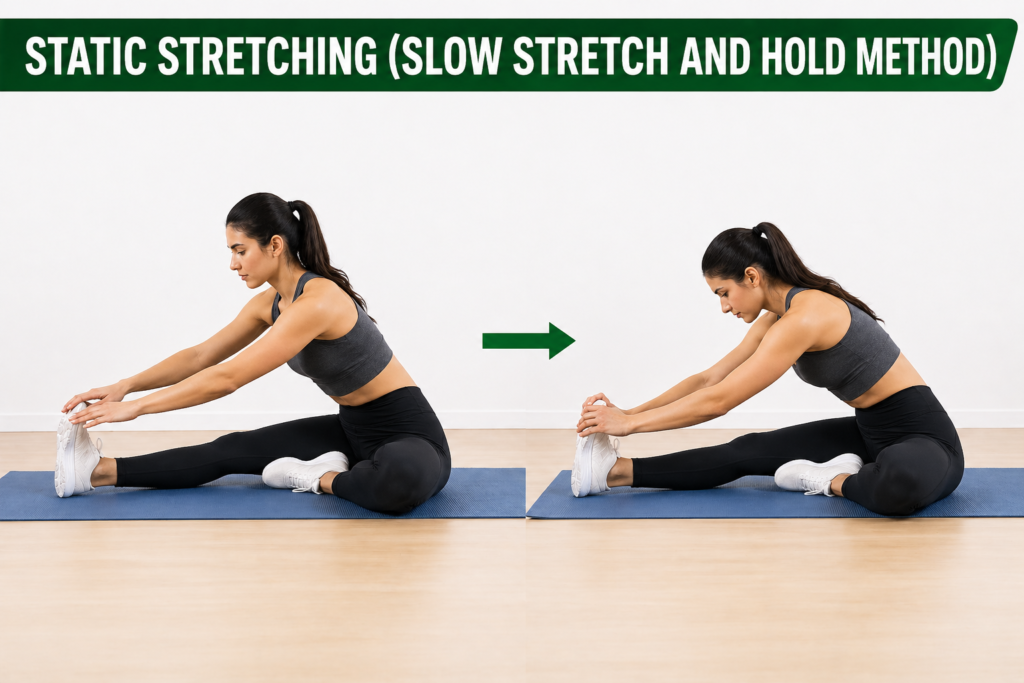
Definition: This method involves slowly extending a muscle to its maximum range of motion and holding the stretch for a prolonged period (usually 15-60 seconds).
Technique: The athlete gradually stretches the muscle until they feel a mild pull, then holds the position without bouncing.
For example- in a seated hamstring stretch, the person reaches forward slowly and holds the position for 30 seconds.
Purpose:
- Increases muscle length and overall flexibility by allowing the muscle fibers to adapt gradually.
- Promotes relaxation and reduces muscle tension.
Benefits:
- Safe and effective for all fitness levels, from beginners to advanced athletes.
- Helps improve flexibility over time when performed consistently.
Post-Isometric Stretching (PNF Stretching)
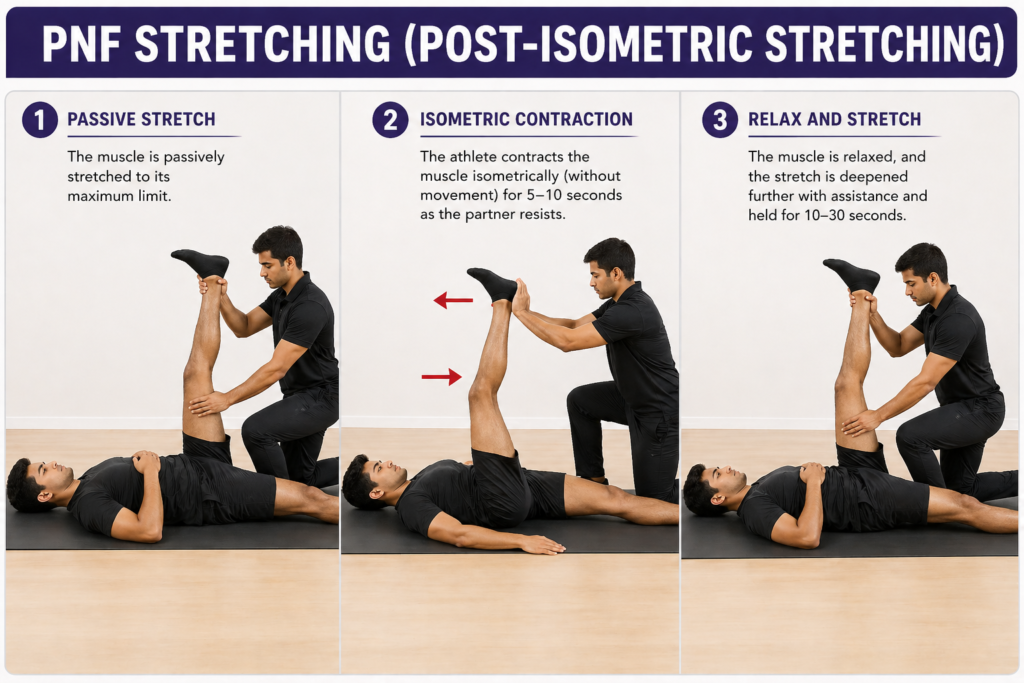
Definition: Post-Isometric Stretching, commonly known as PNF (Proprioceptive Neuromuscular Facilitation) Stretching, is a technique that involves stretching a muscle, then contracting it isometrically (without movement), and then relaxing and stretching it further.
Technique:
- The muscle is first passively stretched to its limit.
- The athlete then performs an isometric contraction (e.g., pushing against a resistance without moving) for 5-10 seconds.
- The muscle is relaxed, and the stretch is deepened, usually with assistance, and held for 10-30 seconds.
For example- in a hamstring PNF stretch, the athlete lies on their back, lifts one leg, and a partner pushes the leg gently while the athlete resists.
Purpose:
- Increases flexibility by activating the Golgi tendon organs, which help the muscle relax more deeply after the contraction.
- Improves both flexibility and strength within the muscle’s range of motion.
Benefits:
- Highly effective for quickly increasing flexibility.
- Helps improve muscle strength and flexibility simultaneously.
Conclusion
Flexibility development is essential for improving performance, preventing injuries, and maintaining overall fitness. Each method—ballistic, static, and PNF stretching—has its own advantages and applications. While ballistic stretching is useful for dynamic sports movements, static stretching is the safest and most widely recommended method for general use. On the other hand, PNF stretching offers highly effective results but requires proper technique and supervision. By understanding these methods and applying them appropriately, individuals can significantly enhance their flexibility and physical performance.
You can also check video Components of Sports Training on our youtube channel.