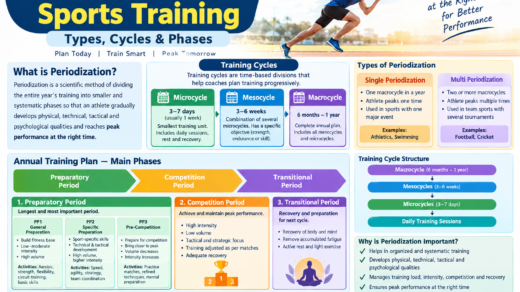
Components of sports training are the essential elements that collectively develop an athlete’s overall performance. These components include physical fitness, technical skills, tactical understanding, psychological preparation, and recovery. Each plays a specific role in improving strength, endurance, skill execution, decision-making, and mental toughness. A balanced and systematic approach to all these components ensures effective training and helps athletes achieve peak performance in competitions.
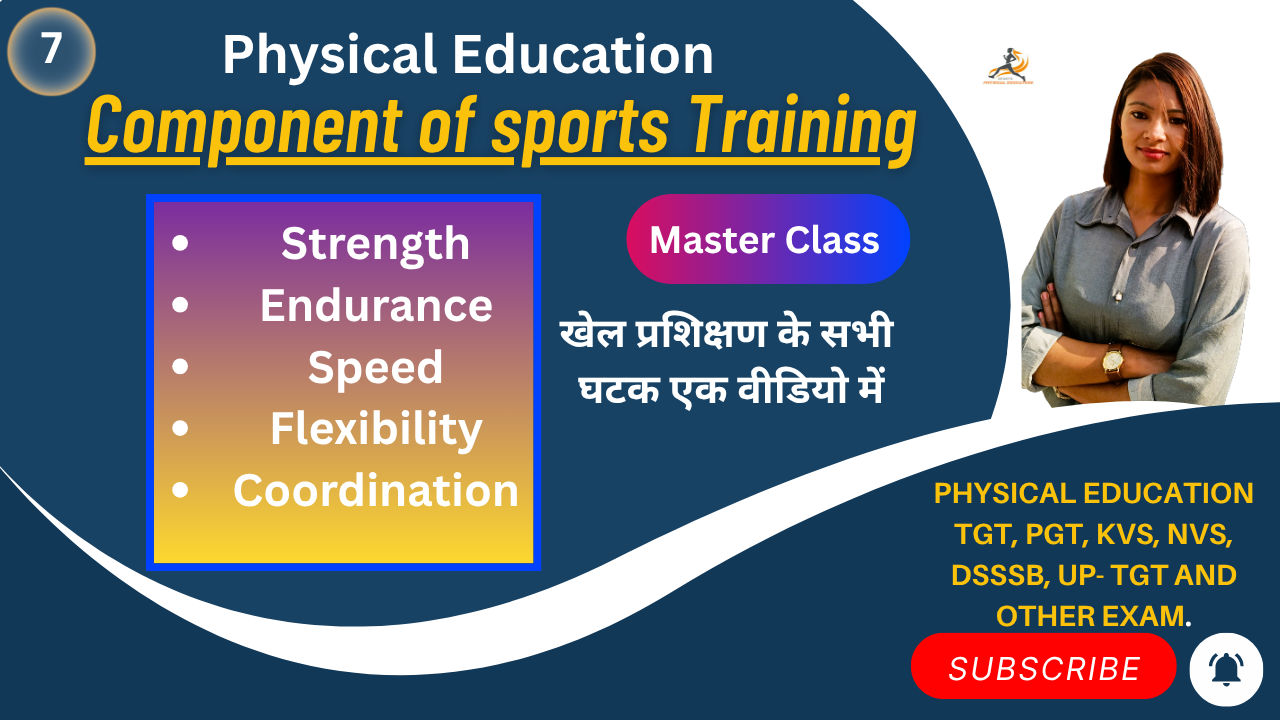
Components of sports training are:
- Strength
- Endurance
- Speed
- Flexibility
- Coordination
Strength
Strength helps you use your muscles powerfully. It is the ability of your muscles to lift, push, pull, or carry heavy things. In sports, strength helps athletes hit harder, jump higher, or resist opponents. For example, weightlifters need a lot of strength to lift heavy weights, while football players use strength to tackle or block other players.
Type of Strength Training
There are three types of strength training:
- Maximum Strength
- Explosive Strength
- Strength Endurance
Maximum Strength
Maximum strength is the greatest amount of force your muscles can produce in a single effort. It’s essential for activities that involve lifting or moving heavy objects, like powerlifting or pushing against an opponent in wrestling.
Example: A weightlifter lifting their heaviest possible weight in one attempt
Explosive Strength
Explosive strength is the ability to exert maximum force in a very short period of time. This type of strength is vital in sports that require quick and powerful movements like jumping, sprinting, or throwing.
Example: A sprinter launching off the starting block or a basketball player dunking.
Strength Endurance
Strength endurance is the ability to repeatedly use your muscles over a long period without getting tired. It is important in sports where athletes need to use their strength continuously, like rowing, cycling, or long-distance running.
Example: A swimmer maintaining strong strokes over a long distance.
Endurance
Endurance is the ability to keep going for a long time without getting too tired. It helps athletes run, swim, or cycle for long distances. Endurance is important in sports like marathon running, swimming, and cycling, where athletes need to maintain their energy and performance over an extended period of time.
Classification of Endurance
Endurance can be classified in :
- Short Time Endurance
- Middle Time Endurance
- Long Time Endurance
Short Time Endurance
Short-term endurance involves activities lasting between 45 seconds to 2 minutes. This type of endurance relies on high-intensity efforts that push the body close to its limits, requiring both anaerobic (without oxygen) and aerobic (with oxygen) energy systems.
Examples: 400-meter sprint, 800-meter race, and swimming 100 meters.
Middle Time Endurance
Middle-term endurance applies to activities lasting between 2 to 10 minutes. Here, the body relies more on the aerobic system for sustained energy but still requires a strong anaerobic capacity for high-intensity efforts.
Examples: 1500-meter run, 800-meter swim, and rowing competitions.
Long Time Endurance
Long-term endurance is required for activities lasting more than 10 minutes and up to several hours. This type of endurance depends heavily on the aerobic system, as the body needs to efficiently use oxygen to produce energy over a prolonged period.
Examples: Marathon running, long-distance cycling, and triathlons.
Speed
Speed is how fast you can move from one place to another. It’s essential in sports like sprinting, football, and basketball, where quick movements and reactions can make a big difference. §Athletes with good speed can outrun opponents, get to the ball first, or finish a race faster.
Types of Speed
- Reaction Ability
- Movement Speed
- Acceleration Ability
- Locomotion/Sprinting Speed
- Speed Endurance
Reaction Ability
The ability to respond quickly to a stimulus, such as a starting signal, an opponent’s movement. This type of speed is crucial in fast-paced sports, such as tennis, boxing, and basketball, where players must make split-second reactions to game developments.
Example: A sprinter reacting to the starter’s gun, A goalkeeper reacting instantly to stop a penalty kick.
Movement Speed
The ability to perform single movement in minimum time. The speed at which specific movements can be executed, often involving the limbs rather than whole-body locomotion. Important in sports where players need quick, controlled movements, such as tennis, martial arts, and fencing.
Example :A boxer throwing a quick punch, A basketball player doing fast dribbling moves.
Acceleration Ability
The capacity to increase speed quickly from a stationary or slow-moving position. Important for sports requiring quick starts and rapid bursts of speed, such as football, soccer, and short-distance track events.
Example: A footballer quickly sprinting after the ball from a standing position, A 100m runner’s first 20 meters from the starting blocks.
Locomotion/Sprinting Speed
The top speed an athlete can achieve during sprinting. Essential in sports where straight-line sprinting is necessary, such as track and field, rugby, and soccer.
Example: Usain Bolt reaching top speed in the middle of a 100m race, A rugby player running at full speed in open field.
Speed Endurance
The ability to maintain high-speed running over longer durations without fatigue. Vital for sports that require sustained speed over time, such as basketball, soccer, and middle-distance track events.
Example: A 400m runner maintaining high speed till the finish line, A basketball player repeatedly sprinting back and forth on the court without losing speed.
Flexibility
Flexibility is the ability of muscles and joints to move through their full range of motion without pain or stiffness. It’s an essential component of fitness that supports overall movement efficiency, injury prevention, and improved athletic performance.
Type of Flexibility
1. Active Flexibility- Active flexibility is the ability to stretch and hold a position using only the strength of your muscles, without any external force or assistance. It improves muscle control and strength within a range of motion, useful in dance, gymnastics, and martial arts.
Examples:
- Lifting a leg and holding it up in a high kick position without support.
- Raising your arm overhead and holding it in place without using the opposite hand for assistance.
2. Passive Flexibility- Passive flexibility is the ability to move into a position and hold a stretch using an external force, such as gravity, a stretching band, another person, or equipment.
Examples:
- Using a strap to pull your leg toward your torso in a hamstring stretch.
- Bending forward and using gravity to deepen a seated forward fold.
Coordination
Coordination is the ability to use your body parts (like hands, legs, eyes) together smoothly and accurately. It helps you do movements in a controlled, balanced, and skillful way — like catching a ball, dancing, or kicking while running.
Types of Coordination Abilities
- Adaptation Ability
- Balance Ability
- Combinatory or Coupling Ability
- Kinesthetic Ability
- Rhythm Ability
- Orientation Ability
- Differentiation Ability
Conclusion
In conclusion, the components of sports training work together to shape an athlete’s complete development. Focusing on physical, technical, tactical, and psychological aspects, along with proper recovery, ensures consistent improvement and peak performance. A well-planned training program that balances all these components not only enhances performance but also reduces the risk of injury and supports long-term success in sports.
You can also check video Components of Sports Training on our youtube channel.